
A second account can add something important without becoming a verdict on the first. Someone may describe an event they observed, explain how it felt to them or decline to discuss it. Those are different contributions. A research summary becomes harder to interpret when it gathers them under a loose phrase such as partner feedback, leaving the reader unsure who answered, what was asked and which experiences remain outside the record.
This article examines how to read a participation measure. The chart supplies a concrete example; the discussion develops a way to reason from that kind of evidence without making absent answers speak. The record examples below are invented teaching examples, not reconstructed participants, validated questionnaires or explanations of anyone's behavior. The aim is to preserve the meaning of an account as it moves from a person, to a form, to a number, and eventually into a claim about care.
Read the reported result
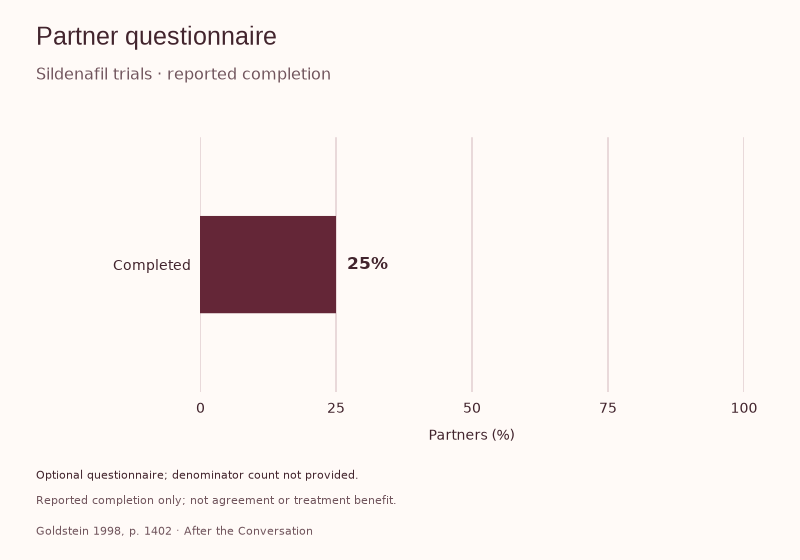
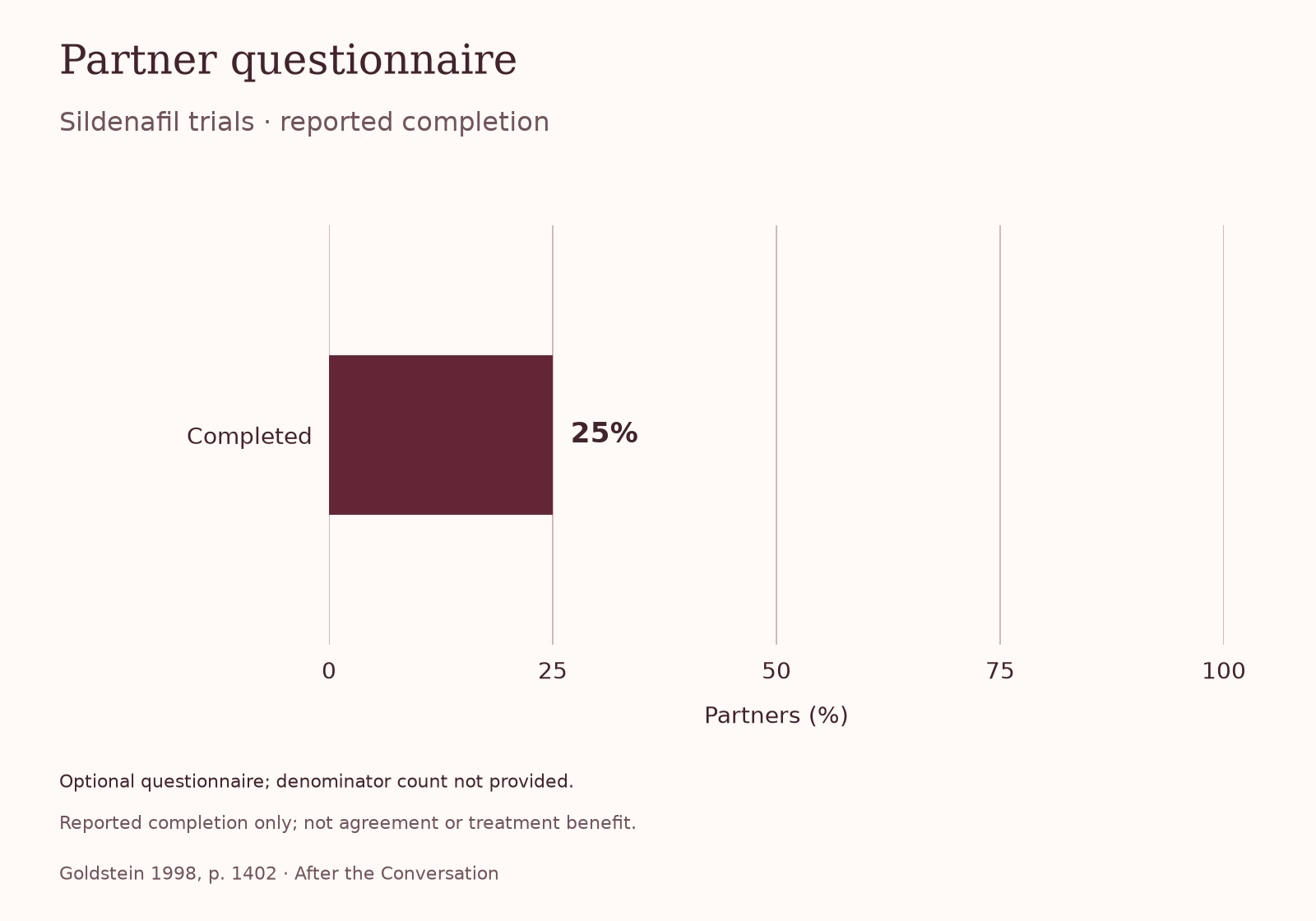
| Measure | Reported percent |
|---|---|
| Questionnaire completion | 25% |
Sildenafil trials: optional partner-questionnaire completion; denominator count not provided.
Participation, not agreement or treatment benefit.
1Follow an account into the record
Consider four steps in a hypothetical reporting process: an invitation reaches someone, that person chooses whether to participate, a response is returned, and the response can be interpreted. Each step answers a different question. Sending a form establishes an opportunity to respond. Returning it establishes that something came back. A usable answer establishes information about a specified question. None of those steps, by itself, establishes whether the person welcomed a treatment or experienced a particular benefit.
To understand a completion measure, first identify the action being counted. Then ask which people the action was possible for, and whether the report supplies a count as well as a proportion. A reader should not silently replace that group with whichever enrollment total appears nearby. A numerical label is useful only while its population stays attached to it.
The same discipline helps outside research. Our guide to a partner's role at an appointment addresses practical preparation. An invitation to contribute can leave room for a choice; it does not automatically make one person the spokesperson for another.
1Keep the speaker attached to the answer
Imagine two empty folders on a desk, one labeled personal account and the other labeled shared event. A person's description of their own comfort belongs in the first folder. An observation that a particular event occurred may belong in the second, depending on the question. Filing both under couple outcome would erase a distinction the reader needs. A couple is a relationship between people; it is not automatically a single respondent with one set of feelings.
This is a question of measurement, not a contest over whose voice is more credible. Two people can have access to different parts of an experience. One can describe their own sensations; another can describe their own understanding. A visible action and a private feeling also require different kinds of evidence. Treating one report as authentication of another person's internal experience changes what the report was capable of establishing.
A useful reading habit is to keep a small label beside every conclusion: who is speaking here? If that label disappears when a result becomes a headline, restore it before interpreting the headline. Respectful language follows the same rule. It describes a person's account without turning that account into ownership of someone else's experience.
1A blank has no direction
A blank answer has an information problem, not an emotional sign. In a fictional record, yes, no and no answer should occupy different positions. Coding a blank as no would manufacture an answer. Coding it as yes would do the same thing in the other direction. Even a neutral-looking midpoint can manufacture a view if the person never selected it. An empty entry needs to remain visibly empty until there is evidence that justifies a more specific interpretation.
It is possible to imagine many reasons for an absent report, but imagining them does not identify which occurred. A form might be unavailable, unwelcome or simply unfinished in a hypothetical example. Listing possibilities can help explain why inference is limited; choosing one as the explanation requires additional observations. Missing information should not become a story about satisfaction, conflict, embarrassment or willingness through the reader's assumptions.
Keep two questions apart: is an account present, and what does that account say? This separation protects both statistical interpretation and personal meaning. The guide to reopening a conversation offers a place to consider a next discussion without treating silence as a ready-made answer.
1Name the question before naming the outcome
The subject of a questionnaire is broader than the thing a particular item measures. A form associated with treatment might ask about an observed event, a remembered difficulty or the person's evaluation of an experience. Calling the whole form a relationship measure would require knowing what its items and scoring actually represent. The treatment setting alone cannot supply that meaning. Context tells us where an answer came from; the question tells us what the answer addresses.
The invented examples in the table show how small changes in wording change the object of observation. They are not proposed screening questions or substitutes for a validated instrument. Their purpose is to make the distinction visible. Someone's awareness that an event happened, their own comfort, and their willingness to discuss it are three different observations. Combining them into one reassuring phrase would discard the differences before any analysis began.
A careful reader can therefore pause at a broad noun such as experience or satisfaction. Ask which specific question earned that noun. If the question is unavailable, retain a narrower description of the information instead of supplying a more ambitious outcome. That restraint preserves a useful finding rather than diminishing it.
| Example wording | What an answer would address | What it would leave open |
|---|---|---|
| Did you notice the event? | The respondent’s awareness | Another person’s private sensations |
| How comfortable did you feel? | The respondent’s own comfort | The other person’s comfort |
| Would you like to discuss it? | A present choice about discussion | Approval of a treatment |
Participation and content need separate summaries
Suppose a hypothetical report has one page describing how accounts were collected and another describing the answers. The first page belongs beside the second when interpreting the result. An eloquent summary of returned answers cannot tell the reader how widely those answers represent the people who could have contributed. Conversely, a high participation count would say little about whether the questions captured a meaningful experience. Collection and content are separate dimensions of a useful record.
This suggests a simple reading sequence. Locate the description of who could respond, then the rule for including a response, then the summary of the response itself. Do not move a number from one stage into another. A participation percentage is not a score for enthusiasm. A count of returned forms is not a count of favorable observations. A description of favorable observations is not automatically a description of everyone whose account was invited.
This sequence also prevents a familiar rhetorical shortcut: treating a visible group as the whole group without explaining why. The appropriate question is about the reach of the available information. It does not require guessing what absent people thought or dismissing the accounts that are present.
1Design a record that preserves uncertainty
The table below is an invented record design, not a dataset. It uses named fields to stop different kinds of information from sliding into the same box. A reporting record should make clear whose response is being summarized, whether it exists, and what the entry means. Those fields are logically separate even when the eventual publication presents only a short sentence. Keeping them separate makes it easier to see the point where evidence ends and an interpretation begins.
Notice that the design leaves a space for unavailable information without filling it with a presumed answer. That is useful because a reader may know that an account was returned while still not knowing the exact item wording. Another record might preserve the wording but lack an answer. Neither should be silently completed from nearby facts. Information can be partial in more than one way.
A real research team would need its own justified collection and analysis procedures. This example establishes no validated method. Its modest lesson is about legibility: if a later reader cannot tell whether a phrase names a respondent, a response or an interpretation, the record needs a more explicit label.
| Field | Example entry type | Reason to keep it separate |
|---|---|---|
| Speaker | Respondent’s role | Keeps the account attached to its author |
| Availability | Present, absent or unavailable | Avoids converting missing information into an answer |
| Question and answer | Wording plus the recorded response | Preserves what was actually addressed |
| Interpretation | A separately labeled explanation | Shows the step beyond the observation |
An additional voice does not become permission
An account about a past event and permission for a future event answer different questions. Even a positive description would not, by logic alone, settle whether someone wants to repeat the event, discuss it publicly or take part in another appointment. A research summary should not be converted into a relationship obligation. This is an ethical boundary in how we use information, not a numerical conclusion about any trial participant.
The distinction also matters when organizing a conversation about care. The person receiving treatment can identify which questions they want help preparing and which they want to discuss privately. A partner can describe their own concerns without needing to supply an interpretation of the patient's feelings. Our shared-space privacy guide provides practical context for keeping those channels distinct.
This need not make a conversation formal or adversarial. It can simply prevent a useful contribution from acquiring an unintended authority. The companion article on daily tadalafil and the meaning of a schedule explores a related problem: a treatment arrangement does not, by itself, define what an experience means to the people involved.
12A product claim needs its own bridge to evidence
Suppose a commercial description moves from a research report to a statement about the experience someone should expect from a service. That move contains several questions: which preparation was studied, which outcome was measured, whose account supplied it, and what evidence connects it to the offered service? These are questions to investigate, not assumptions to fill in from a familiar drug name. A claim can sound personal while resting on information that answers a much narrower question. For example, a statement about a service’s convenience requires observations about that service’s convenience, rather than familiarity with a name.
FDA does not approve compounded drugs or review their safety, effectiveness or quality before marketing. These regulatory facts do not establish a named provider's clinical outcomes.
For a practical document-reading exercise, compare the fields discussed in our Ro sildenafil review and Hims sildenafil review. Those links invite checking attributed terms, formulations and limitations. They do not establish that either service reproduced a trial, collected comparable partner reports or delivered a particular relationship outcome.
13Keep the medication question clinically separate
A discussion of whose experience is represented does not settle whether a medicine is appropriate. Sildenafil labeling lists headache, flushing and indigestion among common adverse reactions. Sildenafil and tadalafil are contraindicated with nitrates or riociguat. An erection lasting more than four hours requires emergency care. Sudden vision or hearing loss calls for stopping the medicine and prompt medical attention. Cardiovascular status and other medicines need clinical review; do not self-combine ED medicines.
Those medication boundaries belong to a different decision from whether someone wishes to share an account. A supportive conversation can help someone formulate a question, but it cannot turn a research participation statistic into an assessment of their medical circumstances. It is useful to keep the questions on separate lines: what does the evidence describe, what does the person want to discuss, and what does a qualified clinician need to assess?
Our first-prescription guide offers a way to organize continuing questions. A prepared question can stay specific without becoming a demand for a particular medicine or outcome. Scientific reading is most useful here when it improves the precision of the question being taken to care.
45Carry the speaker through to the final claim
A practical final check is to rewrite a claim with its speaker and action visible. Instead of beginning with a broad statement about couples, begin with the type of account actually available. Identify the act that was measured, the people to whom it applied and the meaning of the recorded answer. Then ask whether the conclusion introduces a new concept that was never observed. This exercise examines the claim's structure rather than trying to infer anyone's private life.
The process can produce a shorter conclusion than the headline originally suggested. That can be a gain in accuracy. It preserves the information that exists while leaving a clear place for the next question. It also helps distinguish uncertainty about a reporting process from disagreement between people. Those are different problems, and a reader should not solve one by inventing the other. Our guide to questions that remain after a plan keeps that next step grounded in a specific concern.
The enduring lesson is to keep an account connected to the person and question that produced it. A form, a proportion and a summary each compress information. Reading carefully means noticing what survives that compression and declining to manufacture what does not.
1Questions about the evidence
Does a returned questionnaire establish a favorable experience?
No. Returning a form describes an act of participation. Its answers require a separate interpretation based on the questions asked. Even a favorable answer to one item would address that item; it would not automatically establish satisfaction with every aspect of treatment or intimacy.
1Should an absent partner account be treated as disagreement?
An absent account does not supply an answer in either direction. Disagreement requires accounts that can actually be compared on a defined question. Guessing that silence means agreement, conflict or dissatisfaction would replace missing information with an invented observation.
1Can one person answer for the couple?
A person can explain their own observations and feelings. Whether a report supports a statement about both people depends on what was asked and whose information was collected. A useful reading rule is to preserve the speaker's identity instead of allowing the word couple to erase it.
1Does a research citation verify a provider’s relationship claims?
Inspect the preparation, promised outcome and supporting evidence together. A citation needs to support that connection; its presence alone does not establish the results of a provider.
3How can this kind of reading help a real conversation?
It can help separate a question about evidence from a question about personal experience. You might identify what a number measures, then leave space for each person to describe what matters to them. That is an editorial suggestion for organizing questions, not a tested therapeutic method or promised relationship benefit.
1A useful question to carry forward
Begin with the account, not the hoped-for conclusion. Keep its speaker, question and availability visible as you interpret a statistic. An additional perspective can be valuable while still leaving uncertainty about people who did not contribute and experiences that were never measured. That uncertainty is a boundary to preserve, not a gap to fill with a story. A useful scientific question is often the one that makes the next conversation more precise without claiming to speak for everyone in it.
Evidence access
Goldstein full text: retained 2026-10-23, reviewed 2026-10-24, selected passages reread 2026-10-25. Official sources checked 2026-10-25. No separate protocols, supplements or individual records examined. Examples are original illustrations, not study data.
The references
Scientific sources have their own checked dates below. Earlier source records retain their original checks. Provider pages document advertised arrangements; medical and regulatory resources supply general context. Neither implies an endorsement.
- Goldstein 1998Primary research · Checked 2026-10-25
- Porst 2006Study · Checked 2026-10-25
- FDA: compounded drugsFDA guidance · Checked 2026-10-25
- Viagra prescribing informationOfficial prescribing information · Checked 2026-10-25
- Cialis prescribing informationOfficial prescribing information · Checked 2026-10-25