
The word daily tells a reader something about a schedule. It does not tell them how an encounter felt, whether it was wanted or how much room it left for choice. Those questions may matter greatly to someone considering care, but their importance does not make them interchangeable with a treatment timetable. Reading a study becomes more useful when we can name both the question it answers and the different question we still want answered.
This article follows a claim from an arrangement to an experience. The research overview and chart identify a measured outcome; the sections below explain how to examine a proposed connection to spontaneity without assuming that connection has been tested. All scenarios, diagrams in words and example questions are original illustrations. They are not trial participants, clinical questionnaires or evidence that a particular schedule creates a particular feeling. The purpose is to make the steps in an argument visible enough to examine.
Read the reported result
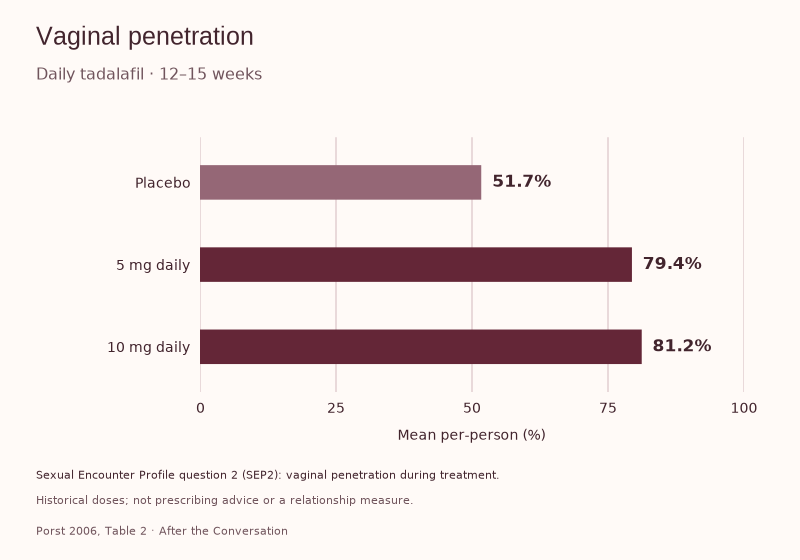
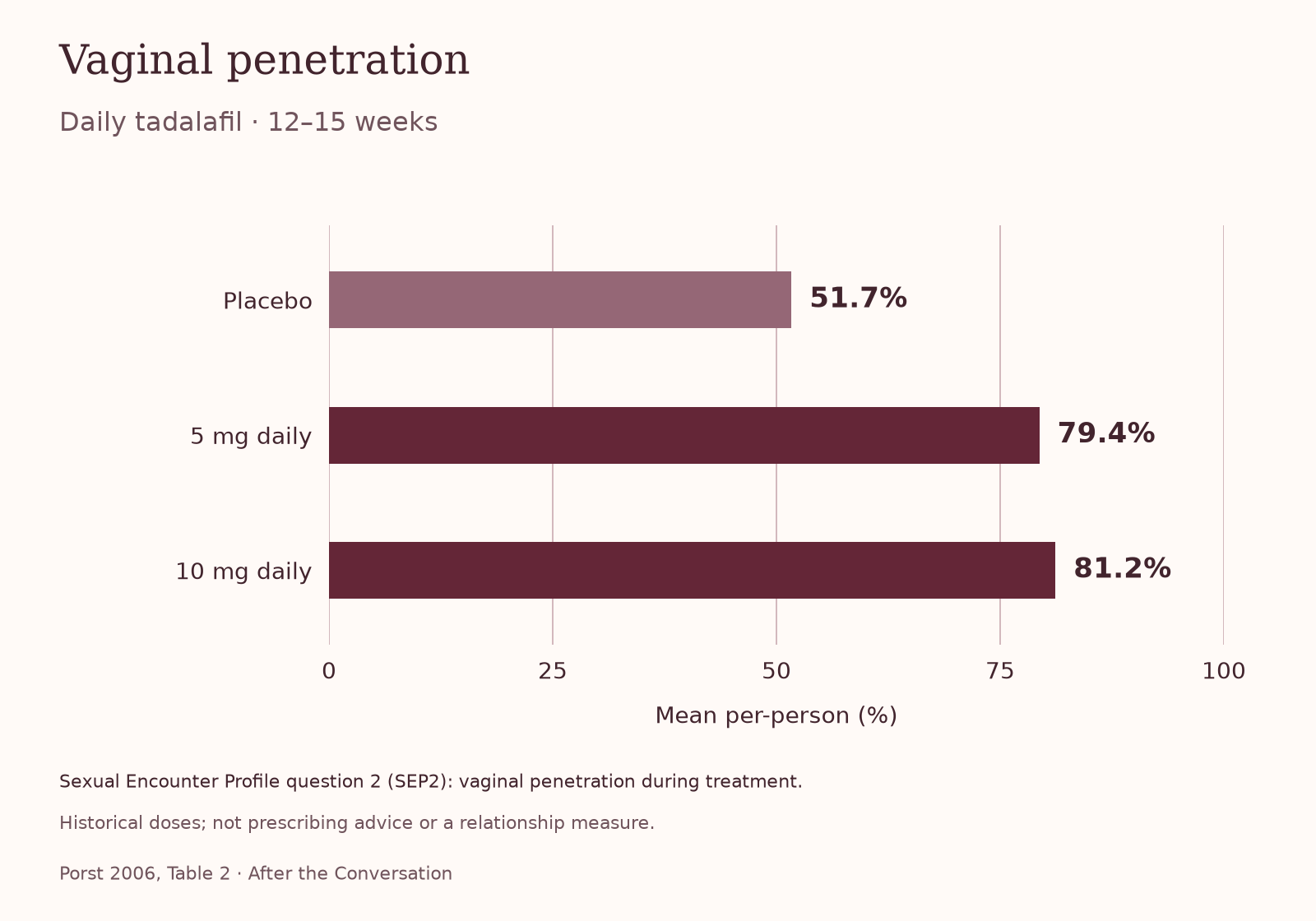
| Group | Mean percent |
|---|---|
| Placebo | 51.7% |
| 5 mg daily | 79.4% |
| 10 mg daily | 81.2% |
Tadalafil: mean per-person SEP2 vaginal-penetration responses during 12–15 weeks.
Historical doses; not prescribing advice, individual probabilities or a relationship measure.
1Start with two different kinds of statement
Write a schedule on one line and an experience on another. The first can specify a repeated action and when it is intended to occur. The second needs someone to describe what happened or how it felt. These statements require different observations. A calendar can document an arrangement without recording whether a person felt hurried, relaxed, distracted or free to change their mind. That difference is present before any statistical calculation begins.
It is tempting to join the lines with an arrow and treat the arrow as a result. For example, a reader might imagine that separating a medicine from an encounter reduces planning, then infer that reduced planning creates spontaneity. Each step is a proposition requiring support. Even when the proposed sequence sounds reasonable, the initial arrangement is not evidence for every subsequent step. A plausible explanation is a candidate for investigation, not an observation.
Our guide to intimacy without a deadline explores a practical conversation about expectations. Here the scientific task is narrower: identify which line was observed and which connecting arrows remain an interpretation. That makes a proposed benefit easier to discuss without presenting it as already established.
1Let an experience have a precise meaning
Spontaneity can be used to describe several ideas. In an invented example, one person might mean not choosing a time in advance. Another might mean feeling able to change plans. A third might mean being less occupied by preparation. These imagined definitions illustrate a measurement problem; they are not findings about how often people hold particular views. A broad word cannot supply its own scoring rule. The researcher and reader need to know which meaning is under examination.
A useful definition should make clear what would count as a relevant observation and whose judgment supplies it. A question about advance planning would require a different answer from a question about freedom to decline. Neither can be answered merely by observing that an event occurred. If the intended meaning changes halfway through an explanation, the conclusion may appear more comprehensive than the underlying information.
This is why careful wording is more than a stylistic preference. It determines the target of the claim. Someone can value an experience that a study did not set out to characterize. Acknowledging that distinct question allows the scientific result and the personal priority to remain visible together.
1An event criterion does not define all of intimacy
An event question needs a rule for recognizing the event. An experience question needs a way for the relevant person to express their experience. Those rules may concern the same encounter, yet they still describe different things. A yes answer to an event criterion does not contain an unstated rating of comfort, pleasure, closeness or willingness. Adding one of those meanings after data collection would change the interpretation without adding an observation.
The distinction also prevents a narrow event definition from becoming a universal definition of sex. A measurement can be appropriate for a particular research question while leaving many meaningful forms of intimacy outside its scope. The reader does not have to dismiss the measurement to preserve that boundary. Instead, describe the result using the event it actually names and ask separately about the experience that matters to the people involved.
For a conversation about care, that can mean making room for more than one goal. The guide to returning to a difficult discussion offers context for expressing a concern without requiring every concern to fit one outcome label. The scientific question remains whether a particular conclusion has the observations it needs.
1Do not change the outcome while reading the percentage
A percentage remains tied to the variable from which it was calculated. Imagine a completely fictional record summarizing whether an event occurred during a set of opportunities. The calculation may be internally correct while telling us nothing about how the event was experienced. Renaming the result a satisfaction percentage would not add satisfaction information. It would attach a new label to an old calculation, leaving the evidentiary gap exactly where it was.
The order of calculation also matters. A mean of people's percentages first preserves a percentage for each person and then averages those values. A pooled percentage instead combines events before dividing. Those procedures can answer different questions because they need not give people the same influence on the final number. Neither procedure automatically turns an event measure into a measure of personal benefit. Numerical precision cannot repair a change in the meaning of the outcome.
The table separates three kinds of claim without supplying invented results. Its right-hand column names information that would be needed, not information we should assume exists. This provides a way to read an impressive-looking number while keeping the scientific question intact.
| Proposed claim | Relevant observation | Information that still needs to be supplied |
|---|---|---|
| The event occurred | A defined event response | How the encounter felt |
| The person felt unhurried | That person’s account of time pressure | Whether the account differs under another arrangement |
| The schedule caused the experience | A comparison addressing that experience | A design supporting the causal interpretation |
Choose the comparison before choosing a preference
Consider a hypothetical experiment comparing arrangement A with arrangement B. Its result addresses that contrast under its particular conditions. A reader who wants to choose between A and C has introduced another comparison. Calling C familiar, common or convenient does not place it inside the experiment. The missing contrast needs evidence of its own; it cannot be recovered simply by giving B a different name in the interpretation.
This matters whenever a treatment schedule becomes a discussion of preference. A preference question might concern burden, flexibility, cost, unwanted effects or another personally important feature. It requires a clear set of alternatives and a defined way to ask about the feature. A comparison of a medicine with a control condition cannot automatically resolve a preference between two ways of using a medicine. Those are different counterfactual questions: what would happen under one specified alternative versus another?
A reader can keep the comparison visible by naming both sides before discussing an effect. Then identify whether the conclusion still concerns those same sides. Our article on whose account a partner questionnaire represents approaches a neighboring problem: preserving the identity of the information as it becomes a broader claim.
12Separate the calendar from the time of observation
A schedule has a time structure, but so does every observation used to evaluate it. An event can be recorded after it happens, while an experience might be described during an encounter, afterward or as a later recollection. Those records refer to different moments. A statement about when a treatment is scheduled does not specify when a feeling was measured or how long that feeling lasted. The observation needs its own time description.
Imagine an invented study asking about anticipation before an event and pressure afterward. Even if the answers came from the same person, they would concern different positions in time. Combining them into one label could conceal that difference. A before-and-after account would also need a defined starting point, not an assumed memory of what the person's life was like. These are questions about research design, not claims that any particular experience improved or worsened.
It helps to draw two separate timelines: one for the arrangement and one for the observations. Mark only what is actually specified. Empty space on the second line is not filled by detail on the first. That simple separation can expose an unsupported inference without requiring a reader to perform a new analysis.
1Ask what an experience study would need to observe
If the question is about an experience, an investigation needs a way to hear about that experience from the relevant person. The invented planning table below illustrates the questions that arise before a number can be interpreted. It does not propose a validated scale, a clinical assessment or a request for readers to disclose intimate information. Its role is to show that defining the outcome is part of designing the research, not an optional step after seeing the results.
A description of freedom to change plans, for example, should identify whose freedom is being described and which period the answer concerns. It should also distinguish a person's own account from someone else's observation. If different people answer different questions, a combined label needs an explanation of how those answers relate. The existence of several records is not itself a rule for combining them.
A credible interpretation would then need to address the comparison, unavailable answers and the limits of the chosen measurement. Naming those tasks is different from claiming they have been completed. It gives the reader a more concrete next question than simply asking whether a schedule is good for relationships.
| Planning question | Example to define | Why the definition matters |
|---|---|---|
| Whose experience? | The respondent’s own feeling | An observer cannot supply an unspoken private account |
| Which experience? | Freedom to change plans | Different meanings need different questions |
| Which time? | A stated observation period | A later recollection is a different record |
| Which contrast? | Specified alternative arrangements | The conclusion must match the comparison |
Personal priorities do not have to become trial endpoints
A person may care about something that is not captured by a particular study. That does not make the concern unscientific or unimportant. It means the research result and the personal priority occupy different parts of the decision. The useful response is to keep both visible: what the evidence establishes within its scope, and what the person still needs to discuss. Treating a study as an answer to every concern would obscure rather than respect the concern.
The reverse mistake is to interpret the absence of a particular experience measure as evidence that nobody had that experience. An unmeasured question remains unresolved. It has not been answered negatively. This is a general rule of inference, and it works in both directions: do not manufacture a benefit, but do not manufacture its absence either. A gap in measurement is a reason to ask a more specific question.
Our guide to reviewing a plan that leaves questions can help organize that discussion. A medication decision should leave room for a person's priorities and an appropriate clinical assessment. No research schedule creates an obligation to have sex, report an encounter or demonstrate a relationship outcome.
1Use current labeling for medication boundaries
Current Cialis labeling describes routine daily ED dosing at 2.5mg, with a possible increase to 5mg. It contraindicates nitrates and riociguat. Common adverse reactions include headache, indigestion and back pain. An erection lasting more than four hours requires emergency care; sudden vision or hearing loss requires stopping the medicine and prompt medical attention. Daily exposure makes interaction review relevant between encounters. A clinician must assess cardiovascular status, other medicines and relevant kidney or liver impairment. Do not combine ED treatments on your own.
Those statements provide medication context, not an interpretation of anyone's relationship. A question about an unwanted effect belongs in clinical care even when the original concern was about intimacy. Likewise, a preference about the timing of an encounter does not determine a safe treatment plan. Keeping those decisions separate prevents a personal goal from being mistaken for a prescribing rule.
The first-prescription guide discusses how to organize follow-up questions. Sildenafil has its own prescribing information and precautions. Neither a chart nor a discussion of someone else's schedule can replace the assessment needed for the actual medicine and person being considered.
34Read the bridge between a study and an offer
When a product description suggests a particular kind of experience, read the connection between the evidence and the promise. Identify the preparation, the proposed outcome and the comparison that would support the claim. These are documentary questions, not a way to predict whether an individual will like a treatment. A phrase about freedom or closeness can be meaningful to a reader while still requiring evidence beyond a medication timetable.
FDA explains that compounded drugs are not FDA-approved and do not receive its premarket safety, effectiveness or quality review. That distinction matters when moving from an ingredient's research history to a particular preparation. It is not evidence about the outcomes of a service. Differences in products and differences in measured outcomes are distinct issues; resolving one would not resolve the other.
Our care-conversation guide helps frame the service question. The Ro daily tadalafil review and Hims tadalafil review provide places to inspect attributed product and service terms. Use them to formulate specific documentary questions. The editorial link does not establish that a provider reproduced the research comparison, measured spontaneity or delivered a predictable experience for a patient or partner.
51Questions about the evidence
Does taking a medicine daily mean intimacy becomes spontaneous?
The schedule alone cannot establish that experience. A claim about spontaneity needs a clear definition and relevant observations from the person whose experience is being described. The arrangement and the feeling should remain separate statements until evidence supports the proposed connection.
1Is a mean per-person event percentage the percentage of men who improved?
No. Averaging each person's event percentage is a different calculation from counting people who meet an improvement criterion. A summary should keep its original unit. Neither calculation automatically measures desire, mutual comfort or the quality of a relationship.
1Why does an on-demand comparison need separate evidence?
A result applies to the alternatives actually compared. Substituting another alternative changes the question. A preference between two schedules would also need a defined preference outcome; it cannot be inferred merely from a result on a different outcome against a different comparator.
1Can I select a treatment schedule from a study chart?
Use current prescribing information and a qualified clinician's assessment for medication decisions. Discuss your goals, other medicines and unwanted effects. A research chart does not provide an individual treatment plan.
3What if the outcome I care about is not in the study?
Name it separately. You can value an experience without pretending the research measured it. Ask what information would address your question and which part belongs in a clinical or personal conversation. An unanswered question is neither proof of a benefit nor proof that the benefit is impossible.
1A useful question to carry forward
Keep three statements separate as you read: the arrangement being studied, the outcome being recorded and the experience someone hopes for. The connections between them are questions to investigate. A carefully described result can contribute to a decision without defining every goal within that decision. That approach lets a reader use scientific evidence precisely while preserving room for personal priorities, optional intimacy and the next question they want to bring to care.
Evidence access
Porst full text: retained 2026-10-23, reviewed 2026-10-24, selected passages reread 2026-10-25. Official sources checked 2026-10-25. No separate protocols, supplements or individual records examined. Examples are original illustrations, not study data.
The references
Scientific sources have their own checked dates below. Earlier source records retain their original checks. Provider pages document advertised arrangements; medical and regulatory resources supply general context. Neither implies an endorsement.
- Porst 2006Study · Checked 2026-10-25
- Goldstein 1998Primary research · Checked 2026-10-25
- Cialis prescribing informationOfficial prescribing information · Checked 2026-10-25
- Viagra prescribing informationOfficial prescribing information · Checked 2026-10-25
- FDA: compounded drugsFDA guidance · Checked 2026-10-25